Jon
I grew up in Sierra Mountains. My family were avid sailors, having boats not only in the San Francisco Bay, but also on the surrounding lakes near our home, Shaver Lake and Huntington Lake. I grew up sailing, but my family is also very passionate about photography and videography, which I also fell in love with. After winning a few film festivals right after high school, I started working in the advertisement field, then moved onto television. For years (which helped pay and save for our boats/ trip), I worked for a television network called Livewell, shooting the shows Motion, and My Family Recipe Rocks till it was time to leave in October 2014.
The Boat
PRISM
1982 Hans Christian 33t
Hull #38
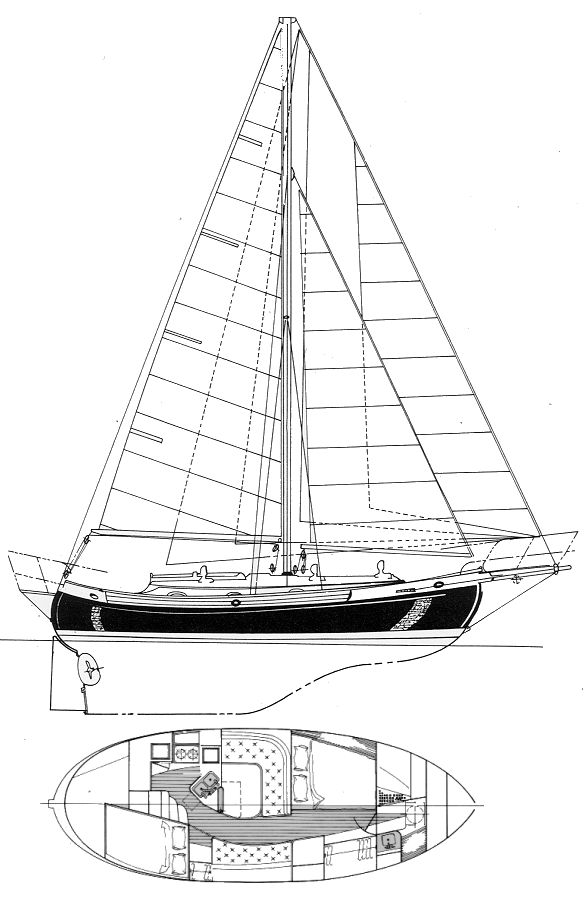
Specs.
Gear:
- Pelagic Autopilot
- Raymarine depth/speed
- Custom KISS watermaker 5 gal/hr
- Icom 718 HF Radio w/ AH-4 tuner, GAM antenna, KISS Ground
- Force10 2 burner marine range
- 5kw forced air diesel heater
Ground Tackle:
- 60 LBS ULTRA Anchor (Primary)
- 55lbs S120 Spade Anchor (Spare)
- 300ft HT 5/16” chain
- 300Ft 5/8” 3-strand Nylon w/30ft 5/16” chain
- Muir Cougar Windlass
- 150ft 5/8” 3-strand nylon w/ 15′ 5/16” chain
- (2) FX16 Fortress Anchors
Deck Gear:
- Fleming Major Windvane
- Fatty Knees 8′ sailing dinghy
- 2hp 2 stroke Yamaha outboard
- MCH-6 Dive Compressor
- Hardtop dodger
Electrical:
- 630AH smart LiFepo4 batteries
- Sterling 1260 DC-DC Charger
- (2) 120watt Renogy Solar Panels
- (1) 200watt Polycrystalline Solar Panels
- Victron Smart solar controllers
- Victron BMV712 battery monitor
Engine:
- Beta Marine Diesel 35hp
- TMC260 Gearbox w/ a 2.8 : 1 reduction ratio
- Fireboy fire control
- Bruntons Sigma Drive
- 18.5″ Kiwi Prop
Sails and Rigging:
- 3/8” 1×19 316 wire for cap shrouds, backstay and forestay
- 5/16” 1×19 316 wire for lowers, intermediate and inner-forestay
- Hi-mod fittings on all
- Crusader Tanbark Mainsail
- Crusader Tanbark Staysail
- Hank on headsails
- High cut Yankee 12oz
- High cut Yankee 7oz
- 110% Genoa 4oz
- 120% Genoa 7oz
- 120% Drifter .5oz nylon with one reef
- Trisail with track on mast
- Storm Jib
- Asymmetrical Spinnaker
History and Facts about the HC33
History
*Designed by Harwood Ives and introduced in 1980, the Hans Christian 33 is the smallest in the family of sturdy double-enders offered by Hans Christian Yachts. Like all boats from the Hans Christian line of that era, the HC33 is a heavy displacement double-ender, solid and seaworthy. She oozes the traditional feel with extensive use of teak inside and out.
At first glance you’ll notice the springy sheerline, large bowsprit and a cutter rig that’s become a favorite among blue water aficionados. Overhangs are quite moderate making for a long LWL for her size and a good hull speed. Below the waterline is a full keel with an aggressively shaped forefoot cutaway and a large rudder that’s hung at the very aft extremity of the boat. Compared to previous Hans Christian boats, the turn of the bilge has been tightened up and the HC33 carries more shoulder in the underwater sections which has resulted in more form stability (righting effort).
She was one of the more innovative boats at her introduction with an internal layout that utilized every nook and cranny that even today has yet to be surpassed. Ives, having designed the previous 38T, 38MkII and 43 moved the interior furniture outwards closer to the hull. The galley was located below the deck and molded fiberglass tankage (both water and fuel) was located in the keel cavity for stability.
What separates the HC33 from the larger boats in the Hans Christian line is her exceptional ease of handling, we’ve heard of a 90 year old skipper who sailed from San Francisco to Turkey with only one crew in tow. Given this and the massive amounts of cruising gear the HC33 can swallow, as much as the HC38 and even the HC41, it’s believable to hear of older owners offering straight swaps of their larger Hans Christian model for the HC33.
Under sail, she’s sea kindly without the tendency to bounce or bob over waves and owners report hoving-to in relatively high comfort when the going gets rough. Fully laden at over 25,000 lbs in typical cruising trim there can be no expectation for fast passages yet the HC33 can perform well, you can expect easy 125 mile days in the trades and we’ve heard of a 7 knot overall average from Mexico to San Francisco via Hawaii. On the lighter end of the wind spectrum, when Yachting Monthly took a factory fresh model for a boat test in flat water and 5 knots of true, they reported slipping along at 3 knots managing to tack through 95 degrees of angle and making 4.4 knots on a reach with 8 knots of wind.
The HC33 was commissioned by Hans Christian Yachts founder John Edwards around 1979 to replace the Hans Christian 34 and her unauthorized stretched sibling, the 36. Various disagreements over the two boats, not only with designer Bob Perry (who did not receive royalties for the bootleg 36 stretch) but also the Union boatyard that owned the molds meant a new 33 would be the easiest path out of strife for Edwards.
By then, Edwards had engaged a new designer, Harwood Ives, described as creative with an uncanny eye for lines, and shared Edwards’ love of traditional boats. Having designed the 38T, 38MkII, and the 43T in the direction set by Perry, the HC33 became Ives’ most technical design challenge to date, resulting in many clever innovations which helped set the course for many boats in what has been described as the “Golden Age” of Taiwanese boatbuilding. For Ives’ work on the Hans Christian boats, it’s interesting to note his payment was his own HC33 from the factory.
The first boats were built at Hansa Yachts Und Shifbau, a new yard located in Taiwan with state of the art facilities. The yard itself was built by former Hans Christian employee Herbert Guttler (a German engineer noted for his genius as a boatbuilder) and his Taiwanese wife, Susan. Hansa continued construction from 1980 through to 1987, the year Hans Christian Yachts ownership passed to its new owner Geoffrey White. Shin Fa Industries, a boatyard located in Taipei, Taiwan took over production in 1988 and these boats, although good, never match the exceptional quality attained by Hansa.
In 1990 Hans Christian operations shifted to Thailand in search of lower costs under the twin pressures of a recession and a Taiwanese luxury tax. In Thailand, Edwards set up a company with the lofty name of Dutch East Indes Trading Company (DEITC) to carry on Hans Christian production for its new owner. We believe one HC33 was constructed in 1992 before production properly recommenced in 1996 under Andersen Yachts Ltd, the boatyard that had essentially risen from the ashes of DEITC.
By 2003 when Andersen’s owner sought retirement, its production manager, a Kiwi by the name of Jack Hall migrated production to his new facilities in Pattaya operating under his own company, Pantawee Marine Ltd. Pantawee presently manufactures all boats from the current Hans Christian line and the Hans Christian 33 is available for purchase at the base price of $297k USD.
In all 155 boats have been produced with the last recorded build in 2009 which shipped to a European dealer.*
Sailboat Data
| Hull Type: | Long Keel | Rig Type: | Cutter | ||
| LOA: | 33.75′ / 10.29m | LWL: | 29.17′ / 8.89m | ||
| Beam: | 11.67′ / 3.56m | Listed SA: | 600 ft2 / 55.74 m2 | ||
| Draft (max.) | 5.50′ / 1.68m | Draft (min.) | |||
| Disp. | 19000 lbs./ 8618 kgs. | Ballast: | 6300 lbs. / 2858 kgs. | ||
| SA/Disp.: | 13.53 | Bal./Disp.: | 33.16% | Disp./Len.: | 341.74 |
| Designer: | Harwood Ives | ||||
| Builder: | Anderson Yachts Ltd. (TAIWAN) | ||||
| Construct.: | Fiberglass | Bal. type: | Iron | ||
| First Built: | 1980 | Last Built: | # Built: | 165 | |
| TANKS | |||||
| Water: | 90 gals. / 341 ltrs. | Fuel: | 80 gals. / 303 ltrs. | ||
| RIG DIMENSIONS KEY | |||||
| I(IG): | 40.00′ / 12.19m | J: | 18.00′ / 5.49m | ||
| P: | 34.00′ / 10.36m | E: | 14.10′ / 4.30m | ||
| SA(Fore.): | 360.00 ft2 / 33.44 m2 | SA(Main): | 239.70 ft2 / 22.27 m2 | ||
| Total(calc.)SA: | 599.70 ft2 / 55.71 m2 | DL ratio: | 341.74 | ||
| SA/Disp: | 13.53 | Est. Forestay Len.: | 43.86′ / 13.37m | ||
**** Info From Sailboatdata.com
It is said that the HC33 is around 19,000 lbs. We have found that we are about 25,000 lbs when fully loaded.
The Route
Prism’s tracks are not to be used for navigation
We started in Olympia Washington in 2013 and now 30,000+ nautical miles later, Prism is on the east Coast of the US. Jon My tracks so you can use them for a reference. If you would like them, you can click the link to Download Prism’s GPS Tracks.
The files can be input into your Chart-plotter devices for reference only. They are compatible with most charting systems.
The Ever-Changing Plans
If there’s one truth about Prism, it’s that the course is never fixed for long. Prism went through a full refit in 2018, and since then, she has remained a strong, capable home. The bigger changes over the years have been about the crew, the direction, and the kind of work Prism will support.
Prism is set to cross the Atlantic this summer to the Baltic region where she will cruise for the summer, the plan after that is still unknown.
 SV PRISM